GA, UNITED STATES, March 2, 2026 /EINPresswire.com/ — Adolescence is a period of emotional intensity and rapid psychological change. A new study shows that adolescents with higher levels of neuroticism—a personality trait characterized by emotional instability and stress sensitivity—report lower subjective well-being. Importantly, this relationship is not direct. Poor sleep quality and lower trait mindfulness serve as key mediators linking neuroticism to diminished happiness. While personality traits are relatively stable, sleep habits and mindfulness skills are modifiable. These findings suggest that strengthening sleep health and cultivating mindfulness may help buffer emotionally vulnerable adolescents from declines in well-being during this critical developmental stage.
Up to 75% of adolescents experience sleep-related problems, including insufficient duration and poor sleep quality. At the same time, subjective well-being often declines during adolescence, particularly under increasing academic and social pressures. Neuroticism—marked by heightened emotional reactivity and sensitivity to stress—typically peaks during this period and has consistently been linked to lower happiness and greater psychological distress. Although sleep health, mindfulness, and personality traits have each been independently associated with well-being, limited research has explored how these factors interact during adolescence. Based on these challenges, in-depth research is needed to examine the roles of sleep quality and mindfulness in the relationship between neuroticism and adolescent subjective well-being.
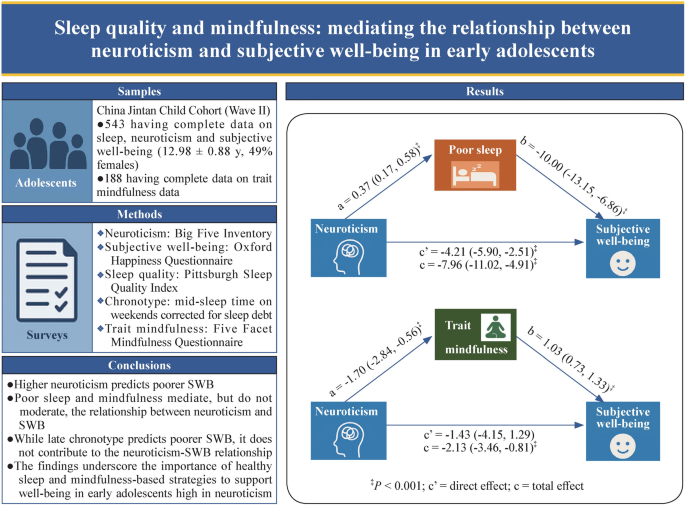
In a study published on October 29, 2025, in World Journal of Pediatrics, researchers from the University of Delaware (USA), the Chinese University of Hong Kong, and the University of Pennsylvania School of Nursing analyzed data from the China Jintan Child Cohort. The research team examined 543 early adolescents to determine whether sleep quality, chronotype, and trait mindfulness moderate or mediate the association between neuroticism and subjective well-being. Using regression analyses and structural equation modeling, the study identified key psychological pathways linking personality traits to happiness in youth.
Participants were approximately 13 years old, and 36% were classified as poor sleepers based on the Pittsburgh Sleep Quality Index. Neuroticism was measured using the Big Five Inventory, while subjective well-being was assessed through the Oxford Happiness Questionnaire. Trait mindfulness was evaluated in a subsample using the Five Facet Mindfulness Questionnaire.
Linear regression analyses revealed that higher neuroticism was a significant predictor of lower subjective well-being. Poor sleep quality independently predicted reduced well-being, and adolescents with a moderate chronotype reported better well-being than those with a late chronotype. However, interaction analyses showed that sleep quality, chronotype, and mindfulness did not moderate the association between neuroticism and well-being.
Structural equation modeling provided deeper insight into underlying mechanisms. Poor sleep quality mediated nearly half (47%) of the total effect of neuroticism on well-being. Adolescents with higher neuroticism were more likely to experience sleep disturbances, which in turn reduced happiness. In a subsample analysis, trait mindfulness fully mediated the relationship, indicating that higher neuroticism predicted lower mindfulness, which subsequently diminished well-being. Chronotype, although independently associated with well-being, did not mediate the neuroticism–well-being pathway.
“Our findings suggest that neuroticism may influence adolescents’ well-being indirectly through sleep disruption and reduced mindfulness capacity,” the researchers explained. “Because personality traits are relatively stable across the lifespan, identifying modifiable mechanisms such as sleep health and mindfulness provides practical intervention targets.” The authors emphasized that adolescence is a sensitive developmental period when emotional regulation systems are still maturing. Supporting healthy sleep patterns and strengthening mindful awareness may therefore reduce psychological vulnerability in youth with higher neurotic tendencies.
The findings carry clear public health relevance. School-based sleep hygiene education, cognitive behavioral therapy for insomnia adapted for adolescents, and developmentally appropriate mindfulness programs may help improve emotional well-being. Given that more than one-third of participants reported poor sleep and a subset showed late chronotypes, early screening and preventive intervention may be critical. Integrating sleep assessment and mindfulness training into pediatric healthcare and school mental health services could enable personalized strategies for at-risk youth. Future longitudinal studies are needed to establish causal relationships and determine whether such interventions can buffer the long-term effects of neuroticism on well-being.
References
DOI
10.1007/s12519-025-00979-3
Original Source URL
https://doi.org/10.1007/s12519-025-00979-3
Funding information
The data from Jintan China Child Cohort was supported by the National Institute of Environment Health Sciences grants (R01-ES018858, K01-ES015877, and K02-ES019878) to LJ.
Lucy Wang
BioDesign Research
email us here
Legal Disclaimer:
EIN Presswire provides this news content “as is” without warranty of any kind. We do not accept any responsibility or liability
for the accuracy, content, images, videos, licenses, completeness, legality, or reliability of the information contained in this
article. If you have any complaints or copyright issues related to this article, kindly contact the author above.